Ask a (hack) luthier!

That's a great post, Doug. Thank you.

You mention "difficult to buff areas". The most common place I see orange peel is on a headstock. Why is that area so difficult to buff?
 
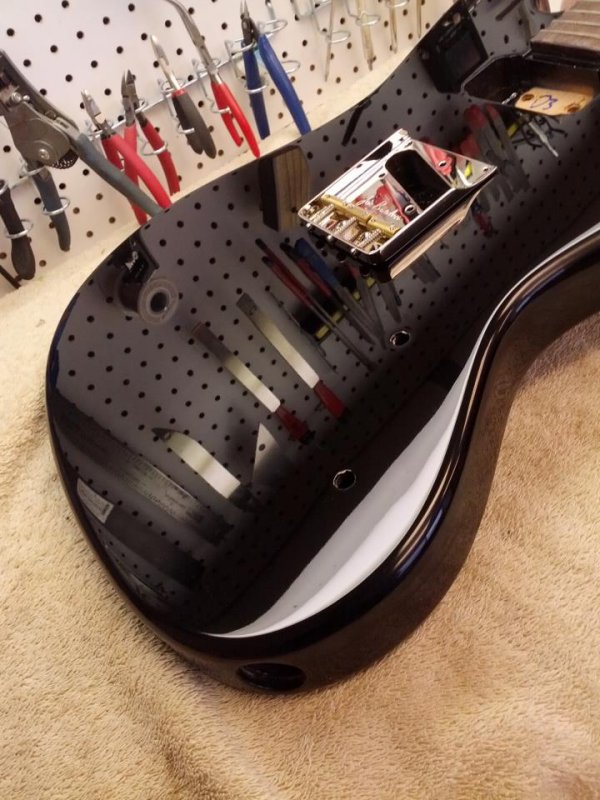
154124074.jpg

after being leveled and buffed.

Schaaaawainng batter batter.........


That's it. After I strike it Rich I'm getting a McFeely for my Fenderish needs and your doing my Gibson types.
 
That's a great post, Doug. Thank you.

You mention "difficult to buff areas". The most common place I see orange peel is on a headstock. Why is that area so difficult to buff?

Headstocks can be tough, cut aways are tough too.

Basically, its a small surface area with lots of sharp edges and has a real knack for getting caught by the buffer and thrown. So many of us will trade a little orange peel for security. :wink:
 
Headstocks can be tough, cut aways are tough too.

Basically, its a small surface area with lots of sharp edges and has a real knack for getting caught by the buffer and thrown. So many of us will trade a little orange peel for security. :wink:

:thu:
 
yeah, that red one is smokin' hot!
I kinda felt my pants get a bit tighter when I saw it.

though that could be the other kind of gas :wink:


seriously though, it's damn hot.
 
Here is a reply I posted on another forum to "making it as a luither". Hope you find it interesting:
(Part 1)
Here's the long and short of it for those of us doing it for a living:

1. It's tough.
2. It's expensive.
3. It will consume all your time.
4. All of us... well the overwhelming majority of us have a spouse that is also supporting us to some extent. I'll come back to this.

Let me extrapolate further:
My History

I fell into doing this. In 11th grade I wanted to be a teacher. Actually, I wanted to teach history as early as 5th grade, its what I knew I wanted to do. I also grew up working for my dad from a very young age and I knew first hand the ups and downs of being self employed and vowed I wouldn't do that.

I went to CSUS, got my degree in Sociology and was working towards a teaching credential. My wife was a bit of head of me (damn those people who can stay focused!) and finished first so I agreed to continue to work my normal job (cabinetry and kitchen design working in the family business) to make house payments while she student taught.

This is when the economy slowed down. Having a previous back ground in running my own internet business that started from a hobby and having said hobby ruined by that business I also vowed I wouldn't do that again. When work slowed, I built more guitars because frankly there just wasn't much else to do with my time. Built more and more and started seeing what I was building improve and catch on with the general public.

Now mind you, I had a (at one point) million dollar shop at my disposal, an incredibly supportive (now working) wife and two sets of parents (mine and hers) who believed in what I was doing. This gave me a leg up on problem #2. (It should be clear that over the last 5 years I've actually bought the majority of equipment from my parents as part of their retirement plan).

Now, was I suddenly a luither? Hell no. Was I in the business of building and selling guitars? Barely. I started off swinging for the fences knowing that I had a lot of ground to cover quickly, which I did. I still look at those early guitars and pride myself on knowing that I've never built a guitar that played poorly and only a couple IMO that were duds (yet their owners love them- just not my bag tonally), those early guitars were rough.

Every year, every month, every day I put a new guitar together, its better than the last one and it should be. I once read someone say that it takes a 100 guitars to really be putting out a quality, near flawless product consistently. I have to agree with that. I'm happy with what we build but I strive for myself (and my team now) to be better every guitar.

Now by all accounts, I've made a successful business. My sales double every year, I have dealers globally. Am I making a living yet? Nope. My two guys do (somewhat) and we all have the startup mentality and it gets better every day. This year we haven't struggled to pay rent, last year we did. Maybe next year I'll start taking home a "salary" instead of just what we need to survive on. Have I mentioned how grateful I am to have a wife with a steady pay check and great benefits?

Before I move onto the next thing, I bet you are wondering why I didn't finish my credential. Funny thing happened, at one point of listening to all the bullshit and hoops my wife has to put up with (the district, the state/fed, whinny bullshit parents, ect ect) I realized you know what, being self employed isn't the worst. At least when I get someone that really pisses me off i can fire them, tell them to GTFO or whatever. Sure, I don't make money but the freedom is nice. (business rule #2- don't tell everyone to go fawk themselves). Ironically, I get to volunteer teach at the local high school from time to time in their guitar building program so I get best of both.

The Pitfalls and the awful truth

This is the part nobody tells you. There are 3 basic camps:

1. You are really talented luither/building guitars
2. You are really talented at running a business
3. You are good at both.

Item 1 has lots of contenders. More than I can shake a stick at as witnessed by the "hobbyist" (I don't mean that as an insult) talent on MLP alone. The internet has been an amazing way to share idea's and information from the most gifted master down to the weekend warrior and I for one am grateful for that. It has also made friends of mine I would have never made otherwise.

It does make the talent pool so deep its hard to be noticed.

Item 2 of course has vast numbers of people. Most of which do not build guitars.

Item 3 is the kicker and IMO there are very, VERY few people who excel at this category. It really seems to be a sliding scale to me. I personally feel I'm a good guitar builder but I'm better at running a business. I learned on the job first hand for over 20 years so I have a leg up there.

Running a business is more than just remembering to pay your tax bill and keeping the lights on. Its marketing, its networking, its how, where and what to spend money on. Its about having a concrete goal about what you want your business to be. Do you want to build 10 guitars a year or 50 or 500 or 5000 or 50,000. How are you going to get there. What are you good at and what are you weak at. Are you willing to let someone improve the areas you are weak at (or hire them to do it). ect ect

Running a business is hard. I've thought often about going back to school and getting a business degree (though it has been suggested by many people who I respect that the 20 years practical experience and contacts gained are just about as good). I do often look back and think that my degree in Sociology actually buttressed and maybe gave me some advantages in other areas of my business.
 
Last edited:
Here is a reply I posted on another forum to "making it as a luither". Hope you find it interesting:

Here's the long and short of it for those of us doing it for a living:

1. It's tough.
2. It's expensive.
3. It will consume all your time.
4. All of us... well the overwhelming majority of us have a spouse that is also supporting us to some extent. I'll come back to this.

Let me extrapolate further:
My History

I fell into doing this. In 11th grade I wanted to be a teacher. Actually, I wanted to teach history as early as 5th grade, its what I knew I wanted to do. I also grew up working for my dad from a very young age and I knew first hand the ups and downs of being self employed and vowed I wouldn't do that.

I went to CSUS, got my degree in Sociology and was working towards a teaching credential. My wife was a bit of head of me (damn those people who can stay focused!) and finished first so I agreed to continue to work my normal job (cabinetry and kitchen design working in the family business) to make house payments while she student taught.

This is when the economy slowed down. Having a previous back ground in running my own internet business that started from a hobby and having said hobby ruined by that business I also vowed I wouldn't do that again. When work slowed, I built more guitars because frankly there just wasn't much else to do with my time. Built more and more and started seeing what I was building improve and catch on with the general public.

Now mind you, I had a (at one point) million dollar shop at my disposal, an incredibly supportive (now working) wife and two sets of parents (mine and hers) who believed in what I was doing. This gave me a leg up on problem #2. (It should be clear that over the last 5 years I've actually bought the majority of equipment from my parents as part of their retirement plan).

Now, was I suddenly a luither? Hell no. Was I in the business of building and selling guitars? Barely. I started off swinging for the fences knowing that I had a lot of ground to cover quickly, which I did. I still look at those early guitars and pride myself on knowing that I've never built a guitar that played poorly and only a couple IMO that were duds (yet their owners love them- just not my bag tonally), those early guitars were rough.

Every year, every month, every day I put a new guitar together, its better than the last one and it should be. I once read someone say that it takes a 100 guitars to really be putting out a quality, near flawless product consistently. I have to agree with that. I'm happy with what we build but I strive for myself (and my team now) to be better every guitar.

Now by all accounts, I've made a successful business. My sales double every year, I have dealers globally. Am I making a living yet? Nope. My two guys do (somewhat) and we all have the startup mentality and it gets better every day. This year we haven't struggled to pay rent, last year we did. Maybe next year I'll start taking home a "salary" instead of just what we need to survive on. Have I mentioned how grateful I am to have a wife with a steady pay check and great benefits?

Before I move onto the next thing, I bet you are wondering why I didn't finish my credential. Funny thing happened, at one point of listening to all the bullshit and hoops my wife has to put up with (the district, the state/fed, whinny bullshit parents, ect ect) I realized you know what, being self employed isn't the worst. At least when I get someone that really pisses me off i can fire them, tell them to GTFO or whatever. Sure, I don't make money but the freedom is nice. (business rule #2- don't tell everyone to go fawk themselves). Ironically, I get to volunteer teach at the local high school from time to time in their guitar building program so I get best of both.

The Pitfalls and the awful truth

This is the part nobody tells you. There are 3 basic camps:

1. You are really talented luither/building guitars
2. You are really talented at running a business
3. You are good at both.

Item 1 has lots of contenders. More than I can shake a stick at as witnessed by the "hobbyist" (I don't mean that as an insult) talent on MLP alone. The internet has been an amazing way to share idea's and information from the most gifted master down to the weekend warrior and I for one am grateful for that. It has also made friends of mine I would have never made otherwise.

It does make the talent pool so deep its hard to be noticed.

Item 2 of course has vast numbers of people. Most of which do not build guitars.

Item 3 is the kicker and IMO there are very, VERY few people who excel at this category. It really seems to be a sliding scale to me. I personally feel I'm a good guitar builder but I'm better at running a business. I learned on the job first hand for over 20 years so I have a leg up there.

Running a business is more than just remembering to pay your tax bill and keeping the lights on. Its marketing, its networking, its how, where and what to spend money on. Its about having a concrete goal about what you want your business to be. Do you want to build 10 guitars a year or 50 or 500 or 5000 or 50,000. How are you going to get there. What are you good at and what are you weak at. Are you willing to let someone improve the areas you are weak at (or hire them to do it). ect ect

Running a business is hard. I've thought often about going back to school and getting a business degree (though it has been suggested by many people who I respect that the 20 years practical experience and contacts gained are just about as good). I do often look back and think that my degree in Sociology actually buttressed and maybe gave me some advantages in other areas of my business.

:thu:
 
(part 2)
Make a plan


Should you become a luither? To be or not to be... that really is the question. I've been thinking about this with the soon arrival of my first child, if he was to ask me the same thing or want to take over the family business.

First off make a plan. Set a goal. Research that goal. Ask people who work in that field. Read EVERYTHING you can. Obsess over it. Drive your friends to the point of desertion, make your parents wish they had ear plugs and stop just short of making your significant other want to bean you over the head. This applies to whatever you might devote your life to.

Second, go to school. College, trade school, community college ect. You will invariably learn important life and social skills there that will always help your future endeavors. If you have a goal, you'll find classes that will directly apply to what you want (and make the ones that don't bearable).

Third, as suggested find locals who work in the field you want to be (again, this applies to most things). Every town has some one who is a luither, tech or goon of some sort. Doesn't mean they are the best or even good but you will learn things. Be proactive, go out and find these people. In the future, no one wants to hire the recluse. I want proactive people working for me, so does the rest of the world.

Learn everything you can. Be open minded. Maybe just being a local tech is all you want and let the business worries fall to someone else. Maybe you want to go work for PRS, Taylor, Fender ect. Learn and experience and maybe open up your own shop one day.

Or maybe you just want to dive in with both feet and let the chips fall where they lay.

My future luither/builder specific advice

Network. Be crushingly nice. Be social. Dont steal. Be original. Work hard. Take constructive criticism.

I LOVE what I do. I also hate it from time to time (anyone of us who has has this moment... mine usually comes from my 4th or 5th fret job for the day). I wouldn't trade it for anything ('cept flying F16's!).

The thing I love most about building guitars is the boutique community. I have done lots of things over the years and NO ONE shares like this community. If you're original, not stealing someone elses designs and your a nice chap to boot, you're in. We ALL talk to each other. There are only (imo) a couple of ego's in this entire community that I can't stand. I've hung out with Roman Rist, Ken Parker, Pete Swanson, Linda Manzer, John Monteleone, Nik Huber, Ron Thorn, Juha Rukongas, Saul Koll, Greg Platzer... have talked to Bob Taylor, met big artists and small, right down to guys who I consider on my level (size wise), Dan Nefeasy (DGN), Mike Potvin, Sam Evans, Michael Spalt, Frank Demiel, Paul Rhoney ect ect. This doesn't even touch the amp guys Adam Grimm, Andy Fuchs or people like Rebecca Dirks and the rest of the PG staff ect ect. There are literally hundreds of names I don't have room to mention.

The one thing you'll see over and over and over again is this is the nicest group of people on earth. We all have the its us vs the big guys mentality so we all help each other out. I share dealer info, building tips, frustrations ect. We all do with each other. If you want to do this for a living, this is the way you should act and treat each other. Listen to those who have been doing it longer than you when they offer insight or advice.

Be ready to work, A LOT. I work 7 days a week, 6 in the shop 10+ hours a day with every spare minute at home used to answer emails, phone calls, drum up business ect. It will be your life.

Parting

OK, now you've seen (I hope) what it's like to be on the inside. Decide for yourself, make that plan and get to work!

BTW this is how long I've been working in the family business.
large.jpg


I take a lot of pride in being where I'm at for 30 years old and keeping alive skills and traditions that tend to be lost more and more with each generation. I also have a father to which I will always be eternally grateful to for not just building the shop I use today but being the role model that proved to me a smart head and hard work can get you far in life.

 
Doug, as a small builder of quality instruments how do you feel about the likes of Deusenberg charging $2,500 for Korean made guitars? I know the quality may be excellent, and they do the in house tweaks and set ups in Germany, but their pricing is excessive despite all of that. As much as I've heard about the quality of some of the guitars coming out of Korea, I would assume their finding for the leftovers from the big American, European, and Japanese companies for quality woods. I'd assume you and your peers have found some great sources that ensure the quality and have developed the expertise to evaluate the wood, but I'm guessing it's far harder for them to get consistently good timber.

I apologize if this has been covered and also don't mean to start a pissing match if it hasn't or gets anyone's knickers in a twist. I know there are some stellar guitar coming out of Korea, but most of them seem to be reasonably priced like the MIJ guitars were in from the '70s-'90s (whereas now the price is about comparable, as the quality has been for the better part of the last four plus decades).
 
Doug, as a small builder of quality instruments how do you feel about the likes of Deusenberg charging $2,500 for Korean made guitars? I know the quality may be excellent, and they do the in house tweaks and set ups in Germany, but their pricing is excessive despite all of that. As much as I've heard about the quality of some of the guitars coming out of Korea, I would assume their finding for the leftovers from the big American, European, and Japanese companies for quality woods. I'd assume you and your peers have found some great sources that ensure the quality and have developed the expertise to evaluate the wood, but I'm guessing it's far harder for them to get consistently good timber.

I apologize if this has been covered and also don't mean to start a pissing match if it hasn't or gets anyone's knickers in a twist. I know there are some stellar guitar coming out of Korea, but most of them seem to be reasonably priced like the MIJ guitars were in from the '70s-'90s (whereas now the price is about comparable, as the quality has been for the better part of the last four plus decades).

First, I think we need to separate what a guitar is worth and what a guitar costs. Worth is always in the eyes of the beholder, just like IS a Picasso worth so much? Is it simply because people say it is?

A 2500 dollar Korean guitar. Honestly? I've played and seen plenty of Duesenbergs. IF you didn't know it was from Korea, would you feel better with it's price tag? It's a nicely built instrument, good playing, good hardware and electronics. So if they are comparable to other guitars at that price point, regardless of country of orgin then sure, why not.

Am I jealous because they probably make 100x per guitar than I do? Absolutely. LOL

Thing about wood is, when you have the buying power of some of the large Korean companies, it's us small guys that are getting the scraps :wink:
 
Doug, as a small builder of quality instruments how do you feel about the likes of Deusenberg charging $2,500 for Korean made guitars? I know the quality may be excellent, and they do the in house tweaks and set ups in Germany, but their pricing is excessive despite all of that. As much as I've heard about the quality of some of the guitars coming out of Korea, I would assume their finding for the leftovers from the big American, European, and Japanese companies for quality woods. I'd assume you and your peers have found some great sources that ensure the quality and have developed the expertise to evaluate the wood, but I'm guessing it's far harder for them to get consistently good timber.

I apologize if this has been covered and also don't mean to start a pissing match if it hasn't or gets anyone's knickers in a twist. I know there are some stellar guitar coming out of Korea, but most of them seem to be reasonably priced like the MIJ guitars were in from the '70s-'90s (whereas now the price is about comparable, as the quality has been for the better part of the last four plus decades).

Your assumption is going in the wrong direction. When buy commodities, volume is king. Do to the sheer volume of guitars coming out of Korean and Asia as a whole. I would be willing to bet they actually consume more wood than most if not all of the the US operations. Many of them are not buying the same grades of wood either.
 
Differing topic here, Doug, but I have a question for you.
This is my guitar that I built for myself.

image.jpg

image.jpg

If you can see it, the bridge is carved from one piece of Honduran rosewood and is only adjustable with a file. :grin:
Now, I of course get a good deal of grief about having a nonadjustable bridge, with tune o matics and such being standard on production guitars and players per cuvée those to be be better because that's what the big guys use.
I was always under the impression that adjustable bridges are there mainly so 10,000 individual players all over the world with different tastes in setups can tweak it to taste. Am I wrong there?

The fixed bridge seems to work out just fine here and I can't recall ever needing to adjust a bridge more than once unless I change the setup.

Apart from being tweak able to taste, does an adjustable bridge offer any other benefit that I'm missing? Cuz, honestly, this guitar sounded way better when I dumped the adjustable rosewood bridge in favor of the one piece.

Please forgive my ghetto speaker cab. That's temporary til I get a real one built. Lol.
 
First, I think we need to separate what a guitar is worth and what a guitar costs. Worth is always in the eyes of the beholder, just like IS a Picasso worth so much? Is it simply because people say it is?

A 2500 dollar Korean guitar. Honestly? I've played and seen plenty of Duesenbergs. IF you didn't know it was from Korea, would you feel better with it's price tag? It's a nicely built instrument, good playing, good hardware and electronics. So if they are comparable to other guitars at that price point, regardless of country of orgin then sure, why not.

Am I jealous because they probably make 100x per guitar than I do? Absolutely. LOL

Thing about wood is, when you have the buying power of some of the large Korean companies, it's us small guys that are getting the scraps :wink:

I wouldn't drop $2500 on any guitar right now, but I definitely buy one from PRS (for a brand name) or someone like yourself without even trying a Deusenberg. Part of it is trust in the consistency of the quality and attempt to elevate your game and part of it is about supporting our "local" economy. The labor practices in some countries, even South Korea, can be questionable (and yes, I know the whole can of worms that opens as I type this on a Asian-built computer and will check stuff on other devices built in even harsher working conditions while wearing closes made by near slave labor...). So it's not just about less than, as good as, or better than.

That said Deusenberg's stuff isn't something I like enough to buy for $750-1,500, were it being sold more honestly as MIK product. As they operate now, their business practices seem questionable at best. I do, however, look at what Joe Naylor does and want to believe that he and Ken had really done their homework and found a place where the product is not only top notch, but the labor is treated fairly and reasonably compensated for their work. And it helps that Joe was straight up about everything as he made the transition from his US-made injection molded guitars to the more traditionally built Korean models.

I've also covered in other threads that I'm old enough to have paid in the $500-600 range for the majority of the MIJ and US-built guitars I've own, so paying more for something built in Korea, China, Indonesia, etc. is hard for me to swallow. This is my issue as most of them were purchased 20+ years ago, but it's a definite hurdle. My two PRSes are from an era of pursuing music as career AND having disposable income...kids make that go away super fast.

I've always thought about what you're saying though. I just don't know if the Korean builders are buying the same quality of lumber and if the higher end stuff (like Reverends) is the highly subjective top quality lumber or the best of what they get OR is it all just one pile and they don't put that same level of concern (for want of a better term) that the US, Euro, and Japanese companies might (and I stress might).
 
Back
Top