


http://www.tonefactor.com/eventide-powerfactor-multi-stompbox-power-supply.html
Description
The Eventide PowerFactor has 10 regulated and well-filtered DC outlets configured in 8 isolated sections. With a total of 1,600mA it's a perfect solution for bigger rigs only with pedals using a DC power source. Its three powerful sections with 400mA each will power up to three Eventide stompboxes. The first 4 outlets, offering 4x100mA, are perfect for standard 9V battery operated pedals.
Eventide PowerFactor Multi-Stompbox Power Supply Features
•10 outlets configured in 8 isolated sections
•Toroidal transformer with additional magnetic field shielding
•3 powerful DC sections for Eventide stompboxes
•Short circuit protection of all outlets
•Advanced LED monitoring of each section
•Temperature monitoring
•115V/230V mains voltage selector switch
•Mounting kit for pedal boards included
•Durable steel enclosure with 2mm thick top
•Size: 158x98x34mm (excl. rubber feet)
•5-year warranty

http://www.creationaudiolabs.com/powertrain1250/

LOW FACTORY DIRECT PRICE: $195
The Powertrain1250 is an extremely low noise DC pedal power system with 5 isolated sections. Isolated sections help break-up potential ground loops and lower the noise floor. Two isolated sections may be connected in series for higher combined voltages, or in parallel for higher combined currents. All outlets are tip negative 5.5 x 2.1mm output.
The First output is isolated and switchable for 9V, 12V, 15V or 18V DC and provides up to 150mA.
CAUTION!!! Some pedals are NOT designed to accept more than 9 Volts. Be very certain of your pedal’s power requirements before trying a higher voltage. We are NOT responsible for any damage caused if the wrong voltage is selected. Always unplug the power from your pedal before switching voltages!
The Next Three isolated outputs are set to 9V DC, provide up to 210mA each and have a Load Dependent Voltage (LDV) control. LDV has the effect of starving some pedals like a weak battery which may have desirable effects on the headroom, distortion, sustain and break-up of certain pedals.
With the LDV trim pot turn all the way up (fully clockwise) the voltage will be fixed at 9V DC. As the LDV is backed down, the impedance increases and the voltage will start to droop in proportion to the amount of current being drawn. Also, as the voltage droops the corresponding LED will start to dim. LDV is an Impedance (not voltage) adjustment. For example, if you were to use a high impedance volt meter to measure the output, you would see very little voltage drop no matter where you set the LDV. However, with a pedal connected as a load, the voltage would drop according to the pedal’s current draw. The complex nature of the impedance makes the LDV respond like a battery to soften up when certain pedals clip or draw more current according to your playing dynamics.
At 100% LDV = Full Power Supply
95 to 100% = Fresh Alkaline Battery
90 to 95% = Fresh Carbon Battery
60 to 90% = Weak Battery
Below 60% = Crazy New Discovery Zone
Note: Many pedals will not benefit from LDV depending on how they handle power internally so run it all the way up for those pedals.
The Last section consists of four paralleled outputs set to 9V DC which provide a total of 500mA. Use these to power all of your pedals that don’t mind sharing power with other pedals. These outputs can also be used with daisy chain cables to allow the powertrain1250 to run many more pedals. How many depends on your pedals collective total MA draw.
THE MAINS VOLTAGE SELECTOR selects between 115 (for 95 to 130V AC operation) or 230 (for 190 to 260V AC operation). Always unplug AC power from the unit before changing the voltage selected!
THE AC POWER INLET is paralleled with an IEC OUTLET to allow AC power to be daisy-chained to an additional powertrain1250 or adapted as needed (for example, to an outlet strip to provide for additional AC power requirements). The outlet is rated to supply up to 10 amps. The use of an IEC outlet allows for operation in 100V, 115V as well as 230V AC POWER markets.
CAUTION! COURTESY AC POWER IEC OUTLET WARNING! Keep in mind that the voltage you supply to input of powertrain1250 will be duplicated at the courtesy outlet. For example; when using the powertrain1250 in the UK with the selector switch set to 230v, the current power of the Output IEC will also be 230v!
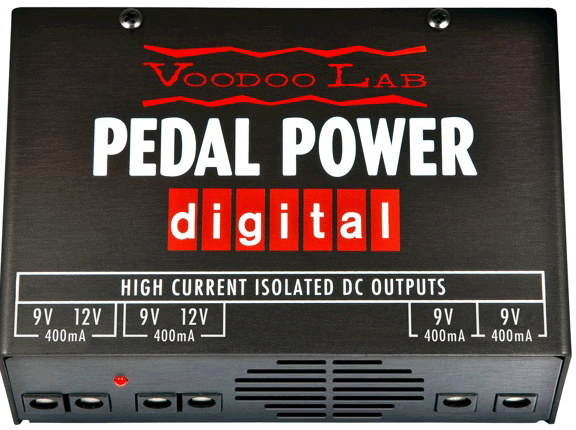
Pedal Power Digital is a compact all-analog, pedal board power supply designed for the higher current demands made by modern digital guitar pedals. I am starting to find that most of the new pedals I get to review are major battery eaters! With typical use or leaving some of them turned on all the time (because I can), I can go through and 'flatten' a nine-volt in hours!
Pedal Power will simultaneously power up to four high-current, digital pedal effects such as the excellent ones from Eventide, Line 6, TC Electronic and Strymon. But know that Pedal Power Digital is also compatible with all 9-volt pedals--so in a sense, you become future-protected by owning a PPD if you ever buy one of those new-fangled, power-hungry effect boxes.
Pedal Power Digital provides four isolated 9-volt, 400mA (nearly a 1/2-amp each) output jacks with two outputs switchable to 12-volt operation. Pedal Power Digital features an analog, linear DC voltage regulation system with substantial filtering and a custom-made toroidal AC power transformer for the lowest possible hum and noise level. All these tweaky details I mention because the reward is a noticeably improved tone and sound when powering your pedals using this box.
Pedal Power Digital is designed and handmade in the USA and comes with a five-year warranty. It sells for $200 MSRP and comes with a detachable AC line cord and all the necessary cables.
Check: www.voodoolab.com.


