
Carbon Zinc made a…

DinoMikeSr

I have the box
…difference for some of my pedals. Reading the Analogman site looking at some fuzz pedals and other stuff. Wrote about using carbon zinc batteries and not Alkaline or lithium. What I remember about these are how they can leak and ruin devices. Anyway ordered adapters so I won’t forget.

I don’t play tube amps and some pedals, fuzz mostly, end up with a very small sweet spot and are disappointing. Using these made great improvement, the biggest on a Big Muff. JHS Smiley as well. The filter button on its side was useless using wart power but works like it should with the battery. When MF had the MXR Hybrid Fuzz half price I got one. Watching and reading a out it prior the design was supposed to reduce harshness but, it didn’t. Using the carbon zinc battery did. Another pedal I had that did sound good was the Mojomojo and using this battery has made big improvements.

The improvement when used here are the notes, for lack of a better word, bloom softly instead of sizzle in harshly.

The battery did not change how the JHS Bender fuzz responded or the Warm Audio Foxy Tone Box with my set up.
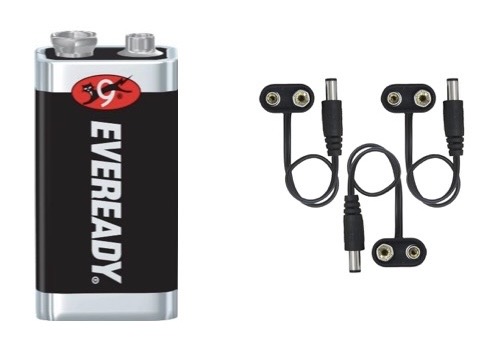
IMG_0718.jpeg
 
I used to bring this up on HC. The majority of people scoffed at the idea. They would bring up Eric Johnson, saying he claimed to be able to tell differences between brands of batteries. That’s an urban internet myth. What Johnson actually said is similar to what’s on the Analogman website regarding carbon-zinc batteries vs alkaline batteries, and dying batteries vs fresh batteries as it relates to vintage fuzz circuits (Fuzz Face circuits in particular).

Modern pedal designs isolate the 9v battery from the rest of the circuit. So, different types of batteries make little, to no, impact on the resulting sound in those pedals.

Vintage fuzz pedals are simple circuits. The battery is typically part of that simple circuit. Therefore, the battery type makes a noticeable difference to the way it sounds. Obviously, clones of vintage fuzz circuits are also affected by the battery.

I happen to own an Analogman Sunface fuzz which is essentially a Fuzz Face circuit. It sounds different with an alkaline battery vs a carbon-zinc battery. I suppose it’s up to the player which battery sound they prefer.

I have also noticed that some pedals sound better with an alkaline battery vs an AC adapter. A pedal that sounds noisy with a wall wart or power brick will sometimes quiet down with a 9v alkaline battery.
 
I used to bring this up on HC. The majority of people scoffed at the idea. They would bring up Eric Johnson, saying he claimed to be able to tell differences between brands of batteries. That’s an urban internet myth. What Johnson actually said is similar to what’s on the Analogman website regarding carbon-zinc batteries vs alkaline batteries, and dying batteries vs fresh batteries as it relates to vintage fuzz circuits (Fuzz Face circuits in particular).

Modern pedal designs isolate the 9v battery from the rest of the circuit. So, different types of batteries make little, to no, impact on the resulting sound in those pedals.

Vintage fuzz pedals are simple circuits. The battery is typically part of that simple circuit. Therefore, the battery type makes a noticeable difference to the way it sounds. Obviously, clones of vintage fuzz circuits are also affected by the battery.

I happen to own an Analogman Sunface fuzz which is essentially a Fuzz Face circuit. It sounds different with an alkaline battery vs a carbon-zinc battery. I suppose it’s up to the player which battery sound they prefer.

I have also noticed that some pedals sound better with an alkaline battery vs an AC adapter. A pedal that sounds noisy with a wall wart or power brick will sometimes quiet down with a 9v alkaline battery.
With the wall wart I pull in the local AM country station with the Smiley with the guitar volume turned down. Turn it up a little, gone. I’m fortunate as my high gain noise levels are really minimum.
 
With the wall wart I pull in the local AM country station with the Smiley with the guitar volume turned down. Turn it up a little, gone. I’m fortunate as my high gain noise levels are really minimum.

Your AC adapter wire was probably operating like an antenna. So, it would make sense that a 9v battery would not pull in radio as well.

My Sunface (Fuzz Face clone) only takes a 9v battery. Even with a carbon-zinc 9v, I’ve pulled in radio stations using the pedal through an amp in my garage at night. It’s a common problem with a FF circuit. That has never happened using the pedal inside my house.
 
I used to bring this up on HC. The majority of people scoffed at the idea. They would bring up Eric Johnson, saying he claimed to be able to tell differences between brands of batteries. That’s an urban internet myth. What Johnson actually said is similar to what’s on the Analogman website regarding carbon-zinc batteries vs alkaline batteries, and dying batteries vs fresh batteries as it relates to vintage fuzz circuits (Fuzz Face circuits in particular).

Modern pedal designs isolate the 9v battery from the rest of the circuit. So, different types of batteries make little, to no, impact on the resulting sound in those pedals.

Vintage fuzz pedals are simple circuits. The battery is typically part of that simple circuit. Therefore, the battery type makes a noticeable difference to the way it sounds. Obviously, clones of vintage fuzz circuits are also affected by the battery.

I happen to own an Analogman Sunface fuzz which is essentially a Fuzz Face circuit. It sounds different with an alkaline battery vs a carbon-zinc battery. I suppose it’s up to the player which battery sound they prefer.

I have also noticed that some pedals sound better with an alkaline battery vs an AC adapter. A pedal that sounds noisy with a wall wart or power brick will sometimes quiet down with a 9v alkaline battery.

This concept just wants to make me investigate what the difference is in the circuit…. Ohm load, measuring the way the capacity ebs and flows… and figure out how to replicate that load at the 9v connector, even if that is coming from a 100v power supply.

I mean, that’s the difference between tube and solid state rectifiers when you hit them with signal and they sag or remain rigid sounding.
 
This concept just wants to make me investigate what the difference is in the circuit…. Ohm load, measuring the way the capacity ebs and flows… and figure out how to replicate that load at the 9v connector, even if that is coming from a 100v power supply.

I mean, that’s the difference between tube and solid state rectifiers when you hit them with signal and they sag or remain rigid sounding
This is my unprofessional understanding. Reading about the carbon zinc battery, even when new, when hit with a power draw the voltage drops each time and recuperates. Where alkaline and lithium perform more in line like a wall wart giving strong constant power until they do not. It’s that “sag” in power that does its
thing.

I was considering getting a device where you can lower the volts provided to the pedal. I watched a video where someone demonstrated the effect on several fuzz pedals. After listening, I thought that’s not what I’m looking for. It was after that when I read the Analogman information. I didn’t have a sample to listen to but it impressed upon me to be the effect I was hoping to get.
 
was considering getting a device where you can lower the volts provided to the pedal. I watched a video where someone demonstrated the effect on several fuzz pedals. After listening, I thought that’s not what I’m looking for. It was after that when I read the Analogman information. I didn’t have a sample to listen to but it impressed upon me to be the effect I was hoping to get.

I don't think it should be lower continuous volts... it would have to be an active process with probably a grid of capacitors that are set to maintain a certain voltage, and then have an active "sag" level built in where they're monitored and set to recharge on a time/surge curve. Ideally, it would be an AC to DC power bank with some kind of sag-speed potentiometer.
 
This concept just wants to make me investigate what the difference is in the circuit…. Ohm load, measuring the way the capacity ebs and flows… and figure out how to replicate that load at the 9v connector, even if that is coming from a 100v power supply.

I mean, that’s the difference between tube and solid state rectifiers when you hit them with signal and they sag or remain rigid sounding.

Tube vs solid state is a good analogy. Carbon-zinc batteries experience more voltage sag under load, while alkaline batteries are more rigid. The battery can change the transistor bias in the circuit which can change the clipping behavior.

In a germanium Fuzz Face circuit, some of the claims are that carbon-zinc batteries create softer clipping, guitar volume knob cleanup improves, feels spongier, smoother sound, less harsh. Alkaline battery claims are that the fuzz can become more gated, has more sustain, tighter bass, brighter sound. What if you want tighter bass? Then, I guess the Fuzz Face gods get angry and strike you down.

Personally, I thought an alkaline battery made my Sunface pedal sound a bit dull. But, the difference was subtle. If carbon-zinc batteries became unavailable, and I had to start using alkaline, maybe it would not be the end of the world.
 
Tube vs solid state is a good analogy. Carbon-zinc batteries experience more voltage sag under load, while alkaline batteries are more rigid. The battery can change the transistor bias in the circuit which can change the clipping behavior.

What got me thinking about solutions to your inquiry is the same kind of thing that Robert Keeley put into the thinking of his Manis pedal (Klon clone).

While Brian Wampler made his silicone diode Klon version and then later the limited edition germanium diode version (which I have and love) which replicates the Klon thing even better.... Robert wanted some options in his, so there is a toggle switch to change it from germanium diodes to a germanium transformer in the circuit. The change ranges subtle to noticeable depending on how high you crank the gain and volume, but it definitely unlocks more gain and bass that most Klons don't have (Love or Hate).

I met Robert at a NAMM event where he was talking about vintage versus current technology... If I get to meet him again, I'll definitely drop this voltage control idea into his brain and see what he does with it. He's way smarter about all of this than all of us put together. :helper:
 
What got me thinking about solutions to your inquiry is the same kind of thing that Robert Keeley put into the thinking of his Manis pedal (Klon clone).

While Brian Wampler made his silicone diode Klon version and then later the limited edition germanium diode version (which I have and love) which replicates the Klon thing even better.... Robert wanted some options in his, so there is a toggle switch to change it from germanium diodes to a germanium transformer in the circuit. The change ranges subtle to noticeable depending on how high you crank the gain and volume, but it definitely unlocks more gain and bass that most Klons don't have (Love or Hate).

I met Robert at a NAMM event where he was talking about vintage versus current technology... If I get to meet him again, I'll definitely drop this voltage control idea into his brain and see what he does with it. He's way smarter about all of this than all of us put together. :helper:

You may be overthinking things. What would be the purpose of coming up with a technology that emulates what happens to a 9v battery in a simple circuit? Maybe, you’d end up with a $200 solution. Meanwhile, you can buy carbon-zinc 9v batteries for as little as $1 dollar.

Carbon-zinc batteries are cheap to manufacture. They work well in a lot of electronic devices. They have a long shelf life. They are not likely to become rare anytime soon.
 
You may be overthinking things. What would be the purpose of coming up with a technology that emulates what happens to a 9v battery in a simple circuit? Maybe, you’d end up with a $200 solution. Meanwhile, you can buy carbon-zinc 9v batteries for as little as $1 dollar.

Carbon-zinc batteries are cheap to manufacture. They work well in a lot of electronic devices. They have a long shelf life. They are not likely to become rare anytime soon.

Wasn't thinking of it as a solution for existing pedals.... I was thinking if he had a pedal with a switch or knob to emulate that kind of tone.
 
Well, carbon zinc batteries. I thought it was bullshit but, I found out different.
Exactly. The way the voltage drops under a load in a carbon zinc battery is different than the voltage drop in alkaline or lithium under the same load.
 
Back
Top